Animal telepathy
A Boy and His DogAnimal telepathy is the central speculative principle of A Boy and His Dog. It is not merely a device that lets a dog speak: it reorganizes survival, warfare, companionship, and love by allowing animals to communicate sense-impressions and exchange meaningful language with humans. Through Blood, the ability makes a dog a guide, teacher, hunter, and argumentative equal, while also exposing the unequal and sometimes brutal purposes to which human beings put enhanced animals.
Origins and Scientific Development
Animal telepathy begins as a product of prewar experimentation rather than a natural miracle. More than sixty-five years before the main action, scientists in Santa Barbara drew and amplified dolphin spinal fluid, then injected it into Chacma baboons and dogs. Altering surgery and grafting followed. The first successful result of this cetacean experimentation was Ahbhu, a two-year-old male Puli able to communicate sense-impressions telepathically.
The process continued through cross-breeding and further experimentation. Its descendants included the first skirmisher dogs, whose selective traits bred true across Dobermans, greyhounds, akitas, pulis, and schnauzers. The history therefore presents animal telepathy as an engineered inheritance, passed through generations rather than confined to one exceptional specimen. Ginger and Ahbhu are identified as Blood’s ancestors, linking Blood’s personal intelligence to both selective breeding and the broader scientific history that preceded the Third War.
The novella also places this development beside an older, more conventional form of canine intelligence. Ginger, a German shepherd bitch working for the Los Angeles Police Department’s narcotics division, could locate marijuana no matter how thoroughly it was concealed. In a test involving 25,000 boxes, five packages were hidden inside several layers of cellophane, tin foil, paper, and sealed cartons; Ginger found all five within seven minutes. Her extraordinary scenting ability is not yet telepathy, but it establishes the canine capacities that human science later enlarges and militarizes.
Operation in War and Survival
The telepathic dogs were developed for the Third War as shock commandos. Over short distances they could communicate telepathically, and, when linked with human controllers, they could track gasoline, troops, poison gas, or radiation. Their ability therefore extends beyond conversation. It becomes a sensory and tactical system, joining animal perception to human military command and making dogs active participants in a new kind of warfare.
That military history has a lasting biological consequence. Dogs such as Blood became highly telepathic but lost the ability to hunt food for themselves. Their enhanced communication and specialized training made them dependent on other groups for ordinary survival. In the postwar wasteland, solos and roverpaks have to find food for them, while dogs use their inherited abilities to serve human needs. The supposed advancement thus produces a new vulnerability: intelligence and usefulness arrive together with dependence.
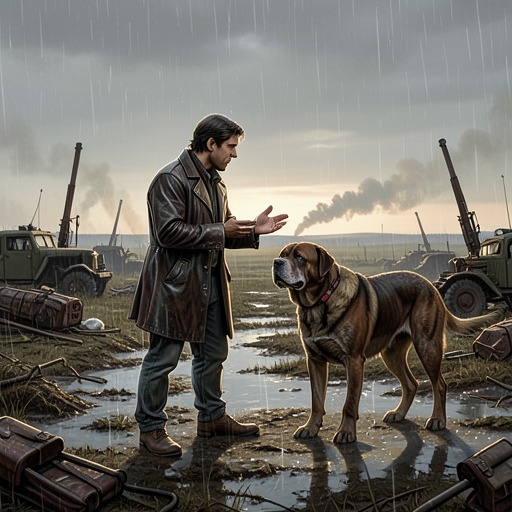
Blood’s practical value in the wasteland is especially direct. Vic travels with him while scavenging the ruins of a war-torn United States, and Blood locates women for the boy, just as he can locate other targets. Blood’s sensory superiority also allows him to detect a woman disguised as a solo when Vic doubts that any dog could have found her. Blood answers that Vic has forgotten who he is, and Vic admits that Blood has taught him so much that he has come to believe what the dog says. Telepathy consequently reverses the expected hierarchy: the human carries weapons and makes decisions, but the dog often possesses the knowledge that makes action possible.
Blood’s Voice and Subjectivity
Blood’s telepathy gives him a voice that is recognizably independent rather than a silent projection of Vic’s thoughts. At the opening, Vic is out with his dog, and Blood deliberately calls him Albert to annoy him, invoking a joke associated with Payson Terhune. After eating water rats and a lost manicured poodle, Blood remains cranky; when Vic orders him to find a sexual partner, Blood replies that Vic is funny when he becomes horny. His humor, memory, irritation, and judgment establish a personality that cannot be reduced to a tracking instrument.
The relationship is also intellectually asymmetrical in ways that complicate human authority. Blood repeatedly tells Vic the history of his ancestors, but Vic has dismissed it until the evidence of the dog’s abilities makes the story credible. The dog is therefore not only a speaking companion but also the keeper of a lineage and a teacher whose knowledge exceeds the boy’s. Vic’s eventual belief does not erase his aggression toward Blood, yet it shows that the human’s understanding of the world has been formed by an animal’s instruction.
A later encounter makes the ability visible to someone outside the pair. When a girl learns that Blood is the dog who accompanied Vic, she reacts with disbelief and then recognizes the rumor that some dogs can talk to animals. Blood begins to respond, but she interrupts him, treating his speech as confirmation of a larger social fact. The scene makes telepathy a source of wonder and political difference: Blood is not simply an unusual pet, but evidence of a population whose capacities challenge ordinary definitions of personhood.
Interdependence and Conflict
The bond between Vic and Blood is materially reciprocal. Blood guides Vic toward women and other opportunities in the wasteland, while Vic ensures that Blood receives food despite the dog’s lost ability to hunt independently. Their partnership is therefore a survival arrangement built from mutual need, but it is not emotionally neutral. The practical exchange is mixed with insults, dependence, instruction, loyalty, and the threat that either partner may place the arrangement at risk.
Animal telepathy also exposes the limits of Vic’s understanding of intimacy. His ordinary encounters are described as hurried acts of grabbing, striking, having sex, and escaping before danger arrives. With Quilla June Holmes, however, physical contact becomes slower and more responsive: she embraces him tightly, relaxes, initiates repeated encounters, and then lies beside him to talk. When she asks about his life with Blood, Vic explains that skirmisher dogs became telepathic but lost the ability to hunt, leaving dogs like Blood to find women for solos. Quilla June offers no reply to this account, and her silence registers the moral unease inside Vic’s supposedly ordinary arrangement.
The dog’s claim on Vic is not only economic. Blood reminds him that he has a responsibility to the dog, invoking a past moment when a burnpit-screamer emerged from the street and tried to seize Vic. This reminder turns telepathy into an ethical bond. Blood remembers shared danger and demands recognition of what the pair owes each other; their partnership is not simply a tool for obtaining food or sex, but a continuing obligation shaped by survival.
Love, Loss, and Significance
Animal telepathy makes the novella’s question of love inseparable from the human-animal bond. After Vic and Blood are forced to move, Blood is limping, and Vic continues to hear Quilla June calling in his head, asking whether he knows what love is. The question persists across separation and danger, but the answer that follows is starkly simple: a boy loves his dog. The ending does not resolve love by turning Vic into a morally transformed adult or by sentimentalizing Blood. Instead, it locates the clearest surviving form of attachment in the relationship the telepathic dog has made impossible to regard as merely ownership.
The concept’s significance lies in this double movement. Telepathy enlarges animal agency: Blood speaks, jokes, teaches, remembers, tracks, warns, and demands responsibility. At the same time, its history reveals exploitation, since scientific alteration produces military instruments and leaves the resulting dogs unable to feed themselves. The story thus refuses both extremes of treating animals as ordinary property and imagining enhanced intelligence as uncomplicated liberation. Animal telepathy is the mechanism through which the novella makes companionship a form of co-survival, while forcing its characters and readers to confront how deeply power, dependence, and love are entangled across the human-animal boundary.